English
 Български


- Wednesday, 04 November 2020
My name is Dobril Zhekov Valchev and I am a water supply, sewerage, and wastewater treatment engineer. I completed my Master’s degree at the University of Architecture, Civil Engineering, and Geodesy (UACEG) in 2016. In July of this year, I successfully defended my PhD dissertation on the topic “Algae-Based Technologies for Wastewater Treatment,” also at UACEG. At present, I work as a young researcher on the project “Clean Technologies for Sustainable Environment – Water, Waste, Energy for Circular Economy” (Clean&Circle). I am also engaged in design activities in the water supply and sewerage sector.
What is your work focused on? (The daily life of a researcher – projects, studies, …)
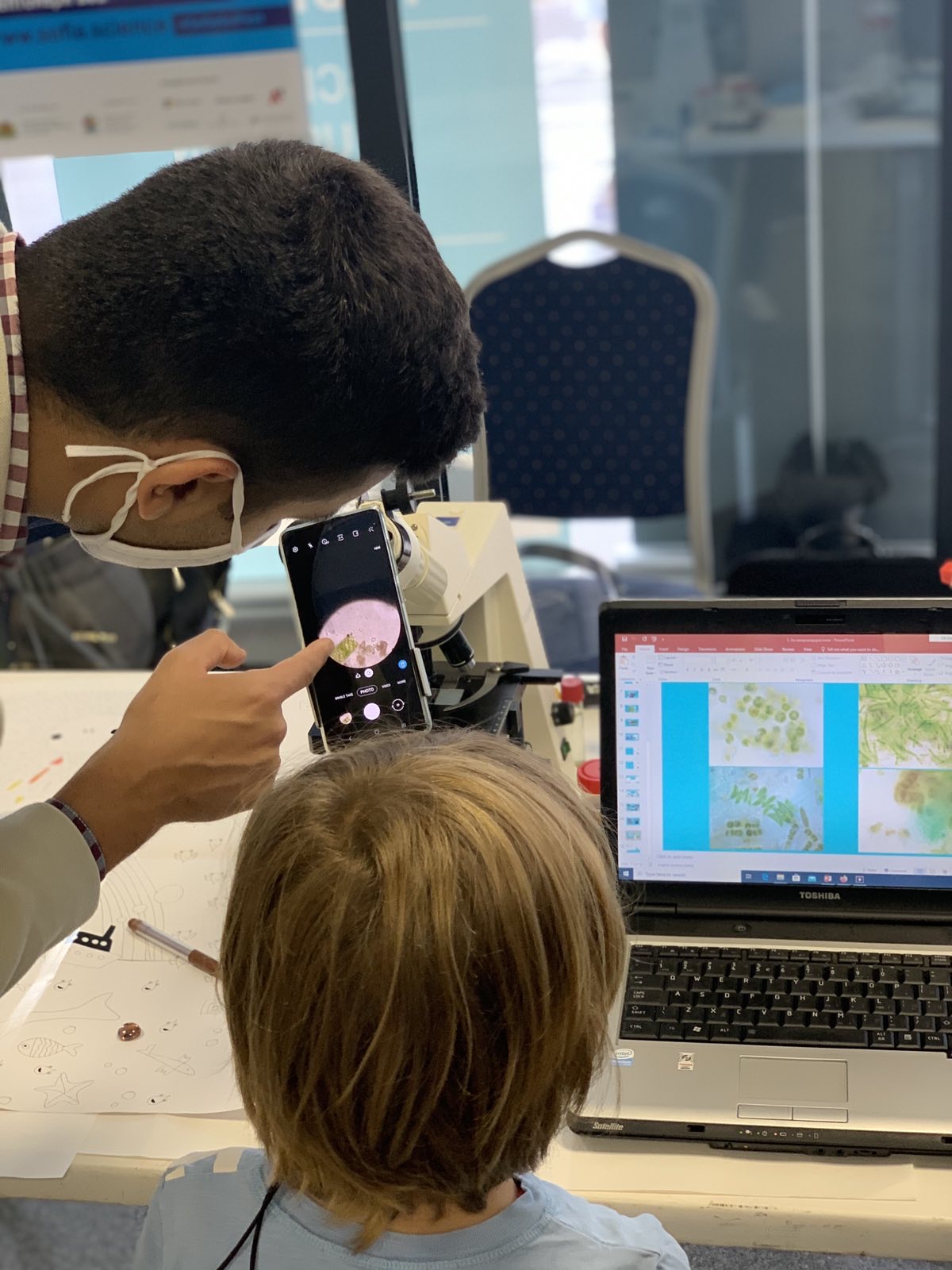
I spend most of my daily work in the laboratories of UACEG. There, I am involved in the development of innovative water treatment technologies and in optimizing processes within water supply and sewerage systems. I study various pollution indicators using both real and model waters, with my analyses primarily aimed at advancing biological methods for wastewater treatment with microalgae.
What are your scientific achievements (contributions), and what is their benefit to society and the economy?
Microalgae-based technologies are rapidly gaining popularity worldwide as one of the future methods for simultaneous water treatment and generation of products suitable for high-value utilization. They are the next step towards a circular economy and closing its cycle in the fields of water and waste. Unfortunately, these technologies are still not efficient enough for wide-scale application – not only in Bulgaria but globally as well. In my experiments, I use laboratory reactors with microalgae species naturally occurring in Bulgaria’s geographical regions. These strains are cultivated by the team of Prof. Maya Stoyneva from the Faculty of Biology at Sofia University “St. Kliment Ohridski.” The strains we have studied show excellent results in terms of removal rate of nutrients from water, easy biomass separation after treatment processes, and resistance of cultures to pollution. The achieved results raise the technology’s readiness level and provide a vast field and potential for future pilot and real-world applications.
What motivated you to choose the profession of a researcher?
For me, working as a researcher is primarily driven by curiosity in the field of interest, dedication to the cause, and the desire to develop something useful. These aspects, along with the synergy built within the team I work with, motivate me to continue developing myself as a scientist.
What contributed to your development as a researcher? (training, supervisor, work in industry, scholarship abroad, team, …)
I owe a huge part of my development to my scientific supervisor – Prof. Irina Ribarova, who supports and advises me in every direction, and with whom I continue to work even after the defense of my doctoral dissertation. Furthermore, my collaboration with multidisciplinary teams of researchers from UACEG, the Faculty of Biology at Sofia University “St. Kliment Ohridski,” and Fachhochschule Nordwestschweiz in Basel (where I had the opportunity to work in their laboratories for 2 months during my PhD) has significantly contributed to my growth as a researcher.
You can read the full interview on the BG Science website.